
Corporate Ecometrics: Why Measuring Organisational Health Protects Your Profits
Your strategy is flawless on paper. The budget is approved. But performance is inexplicably bleeding out into silos and apathy. Discover how translating invisible human dynamics into actionable ROI data changes the leadership equation entirely.

Claudina Hafenscher
Managing Director & Ecometric Practitioner
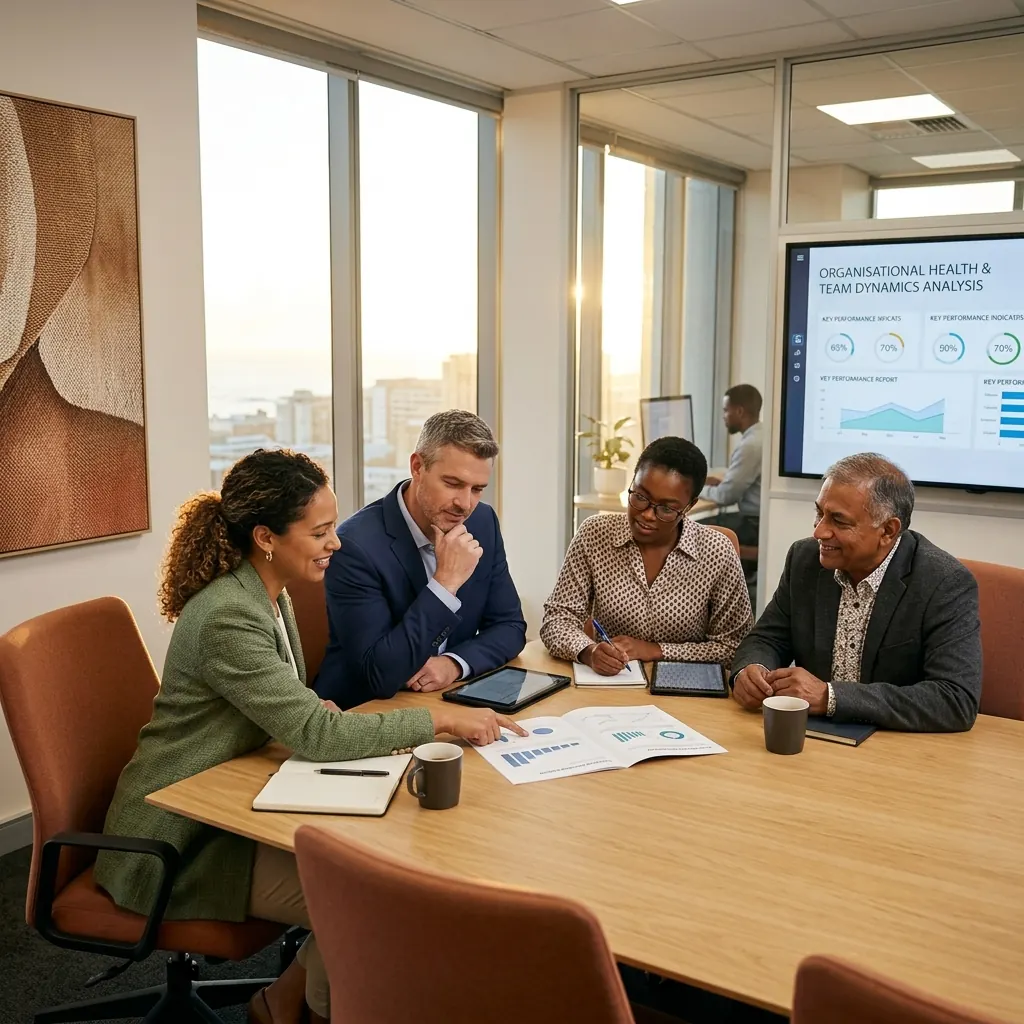
Three months into a major restructuring, a tech client brought me in. Their strategy was fundamentally sound. The long-term budget was signed off by the board. The problem? Key talent in their most profitable division was quietly walking out the door, and the executives who stayed were spending significantly more time managing internal friction than building actual products.
The executive team had been managing operational metrics aggressively via endless spreadsheets, KPIs, and dashboards. But they were flying blind when it came to measuring the one thing actually driving their execution failure: the baseline health of their organisation.
Most leadership teams accept the cliché that humans are their greatest asset. But when it comes to measuring the actual health of that asset, they usually rely on terrible, lagging indicators. They look at exit interviews filled out by people who have already detached. They glance at annual employee satisfaction surveys that nobody takes seriously. They track illness rates. By the time those numbers look bad, the damage to the company culture and productivity is already deeply entrenched.
What is corporate ecometrics?
Ecology is the science of the relationships between living organisms and their environment. When we talk about human ecology, we are exploring the collective interaction of people with their specific surroundings.
Corporate ecometrics translates this to the workplace. It is simply the scientific quantification of employee behaviour within a defined corporate environment.
If you cannot measure something, you cannot manage it effectively. The Reality Check EcoMetric™ is a technology-based diagnostic tool that gives management a precise, numerical metric on the organisational health of their people. It shifts well-being from a vague HR buzzword into a strategic, measurable asset that protects profits.
The definitive data on organisational health
We do not have to guess about the ROI of a healthy workplace culture anymore.
A sweeping decade-long survey conducted by McKinsey & Co. involving over 500 organisations and 600,000 participants reached a definitive conclusion. They found that the ultimate, sustainable competitive advantage a company can build is not its product strategy. It is not even its financial runway. It is organisational health.
When an employee's well-being drops, the business inevitably takes a hit. We see this play out in intensely predictable ways across departments. It starts as reduced productivity. It escalates into an increased rate of sloppy errors. Soon, conflict begins brewing between teams that absolutely need to be collaborating to ship a product. Grievance incidents rise. Finally, the quiet, pervasive drag of low morale begins to poison customer service and client relationships.
The cost of the checked-out employee
The Gallup Organisation has studied employee engagement extensively for twenty-five years. Their findings draw a clear, uncomfortable line between the mental state of an employee and the financial output of a company.
Their research essentially splits the workforce into three measurable groups.
Engaged employees work with a degree of passion and feel a profound connection to their company. They are the ones actually driving innovation and moving the organisation forward against friction.
Semi-engaged and not-engaged employees are effectively sleepwalking through their workday. They are putting time (not energy or passion) into their roles. They do exactly what is asked of them, nothing more, and they mentally check out the moment their shift concludes.
Then we have the actively disengaged employees. These individuals aren't just internally unhappy. They are busy acting out their unhappiness. Every single day, these workers steadily undermine the momentum that your most engaged people are fighting to accomplish.
The Human Capital Balanced ScoreCard
To fix engagement, we need superior data. We achieve this through the Human Capital Balanced ScoreCard (also known as the Well-Being Indicator). This tool assesses the pulse of the organisation, the division, the specific business unit, and the individual, giving leadership a highly accurate "snapshot" of the current state of wellness.
This isn't about setting up a ping-pong table in the breakroom. Dr. Juniper defines this critical measurement as "that part of an employee's overall well-being perceived to be determined primarily by work and can be influenced by workplace interventions."
We specifically measure factors such as perceived expectations, the locus of control, general job satisfaction, accumulating frustrations, and stress levels. Understanding these hidden workforce risks allows executives to anticipate problems before they sever profit margins.
Measuring Personal Driving Dynamics
Every employee operates with a unique language of expression, prioritised into a personal hierarchy. You can think of this as their internal engine room.
This is where measuring Personal Driving Dynamics (PDD) comes into play. All employees want to be understood. When we assess a team's PDDs, we gain the ability to match the working environment to the specific drivers of each person on the team. Managers stop managing blindly. They learn exactly what motivates the individuals who report to them.
Moving from diagnostic mapping to execution
Raw psychological data without intervention is just corporate overhead.
Measuring the health and risk of your workforce is the crucial first step. But the actual value materialises in what you decide to do next. As a certified Ecometric Practitioner, I use tools like Reality Check EcoMetric™ to map the terrain. Then, I pair those robust metrics with active, corporate facilitation.
When the data highlights deep, hidden friction points in an executive team, I do not just hand over an eighty-page PDF report and leave the building. We use proven methodologies to actively shift the room. We employ the Positive Intelligence framework to identify the mental Saboteurs ruining collaboration. We might use Educational Kinesiology movements to quite literally shift teams out of fight-or-flight stress patterns back into higher cognitive function.
If the data shows a leadership team is highly defensive and working in protective silos, we use deliberate team alignment coaching to systematically dismantle those barriers and build genuine trust.
Culture stops being a guessing game. It becomes a strategic execution.
Tired of managing symptoms instead of root causes?
If your leadership team is frustrated by repeated execution failures or unexplainable friction, you likely have an invisible data gap. Have & Share partners with C-suite teams who are serious about treating organisational health as a measurable business strategy.
Need a clearer way forward for your team?
Message Claudina to discuss team alignment, facilitation, or a Reality Check conversation for your leadership group.